Three objects of study
A work, a surviving copy of that work and a digital image of the copy are related but distinct. The work may have circulated before the surviving volume was made. The volume may include later notes or repairs. The image records selected surfaces under particular conditions. Specify which of these your argument concerns.
The Michigan collection overview describes manuscripts across many subjects, including jurisprudence. Use the catalogue to identify a candidate, then record the shelfmark, attributed title, language and any dates or uncertainties supplied by the library. A collection-level description cannot establish the contents or date of an individual volume.
Describe before interpreting
Keep a short observation record for each folio: image identifier, visible page or folio number, text area, marginal material, damage and the reason the page matters to the research question. Distinguish what you can see from what a catalogue or earlier scholar tells you. If a note is illegible, preserve that uncertainty.
A Library of Congress digital collection can supply both images and descriptive metadata. Read the rights statement for the specific object before reproducing it. Availability online and permission to reuse an image answer different questions. Record credit information when you save the image, while its source is still easy to identify.
What the cover can tell us
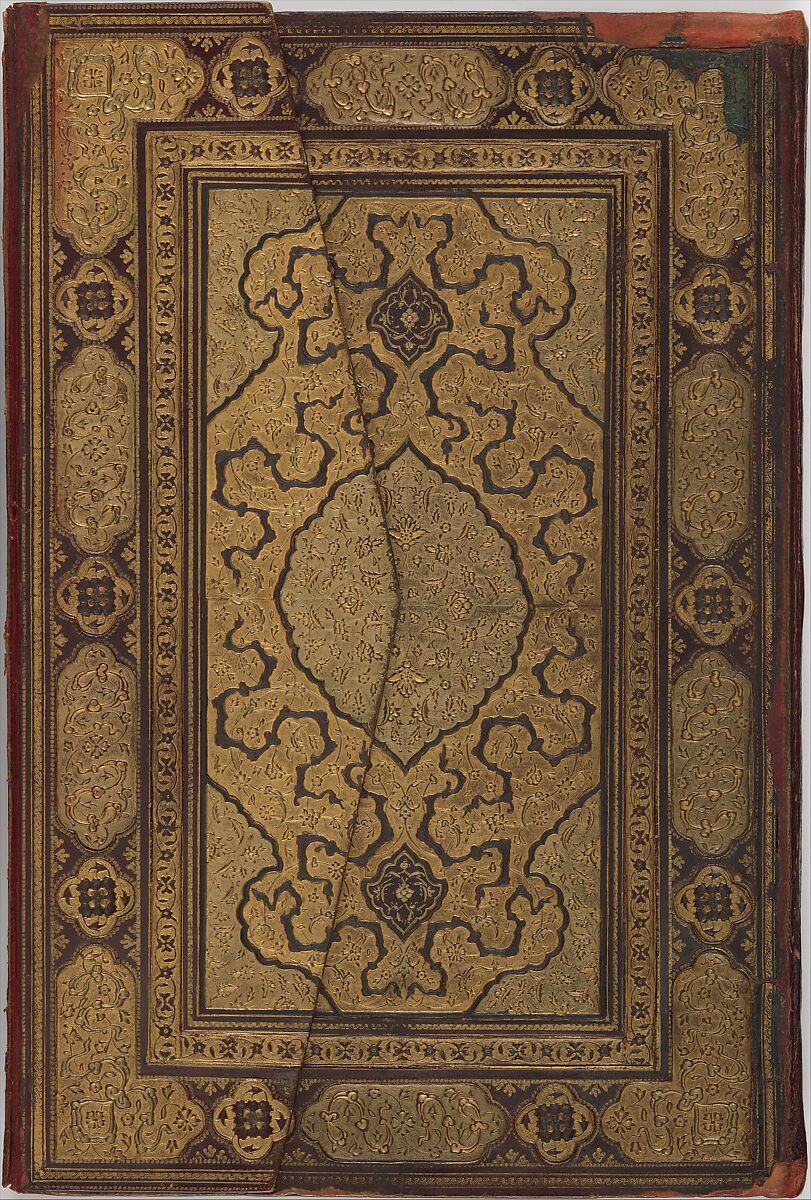
The bookbinding photographed in this journal belongs to a copy of the Mantiq al-Tayr, a literary work by Farid al-Din Attar. The Met's record dates the binding and text-block to about 1600 and locates their production in Isfahan, Iran. It identifies leather, gold and color among the binding materials and marks the image as public domain.
This is an illustration of book culture, not a manuscript of jurisprudence. Its decoration can introduce questions about materials and circulation; it cannot establish the content of an unrelated legal text. The same discipline applies to research illustrations more generally: give an object a precise caption and let the evidence determine the reach of the claim.
References
- University of Michigan: Islamic Manuscripts
A collection spanning jurisprudence, language, literature, science and other subjects.
- Library of Congress: Arabic, Persian and Ottoman Calligraphy
Digitized objects, catalogue descriptions and item-level rights information.
- The Met: Binding for the Mantiq al-Tayr
The public-domain bookbinding photograph used in this journal. Iran, Isfahan, circa 1600; accession 63.210.67.
Filed under Manuscripts & history. Sources and corrections.